In 2025, businesses are facing a new challenge in how they connect with customers online. Traditional search engine optimization (SEO) has been the foundation for improving website visibility for years, but now a newer approach called Generative Engine Optimization (GEO) is reshaping the way content gets discovered. Understanding the differences between these two methods—and how they work together—is key to staying ahead in a rapidly changing digital world.
At this important marketing crossroads, knowing when to use SEO or GEO can make all the difference in reaching your audience effectively. Let’s dive into what sets them apart, how they complement each other, and why both matter for your business today.
What Is GEO vs SEO? The Core Differences
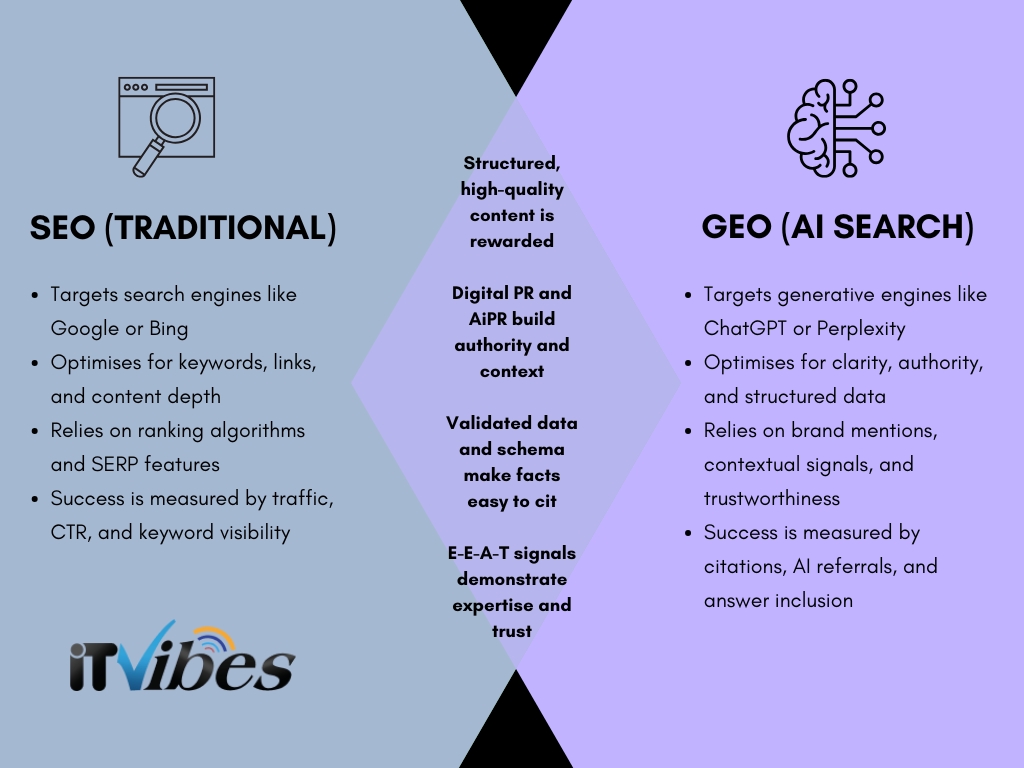
SEO stands for Search Engine Optimization. SEO works by using keywords, links, and good website structure so search engines can easily find and rank your content. When people type a question or phrase into a search engine, SEO helps your website appear on the list of results. SEO focuses on choosing strong keywords, creating helpful and relevant content, and building links so search engines trust your website. When SEO is working well, you will see more organic traffic, better click-through rates, and stronger keyword rankings.
GEO, or Generative Engine Optimization, is a newer way to get your content found by AI-powered search tools like ChatGPT or Perplexity. Instead of focusing just on keywords, GEO focuses on making your content clear, helpful, and easy for AI to understand and use in its answers. The goal is to have AI include your content in its direct responses to user questions. These tools do not just scan for keywords. They look for clarity, authority, and well-organized information that they can confidently use in responses. Success in GEO is measured by how often AI tools mention your brand, cite your content, or include you in the answers they provide to users.
So, the main difference is this: SEO helps your website rank in traditional search results, while GEO helps your content get used by AI engines to answer questions directly. Understanding these differences is key for businesses trying to reach customers in today’s digital world.
Where SEO and GEO Come Together
Even though SEO and GEO focus on different search environments, they overlap in an important way: both reward high-quality, accurate, and well-structured content. Whether someone is searching on Google or asking an AI tool a question, both systems want information that is easy to understand and trustworthy.
This is where ITVibes can help. We focus on building content that works for both search engines and generative engines by combining strong SEO practices with clear, structured, factual information that AI can easily interpret and cite. We also incorporate Digital PR and AiPR strategies that strengthen your authority across the web and create the kind of brand signals AI systems rely on.
To stay ahead, we recommend that businesses invest in content that shows real expertise, provides validated facts, and uses structured data whenever possible. The companies that combine SEO with GEO now will be the ones that earn visibility across both search and AI platforms as things continue to change.
Geo vs SEO: Which Drives Better Results in 2025?
Choosing between GEO and SEO depends a lot on your business type and what your customers want. SEO is still great for companies that need to appear in traditional search results, like when users want to browse websites, compare products, or read detailed information. On the other hand, GEO shines when users want quick, clear answers from AI tools, or when content needs to be easy for AI to find and explain.
Understanding when each method works best can help your business get the most from its marketing efforts. Below is a table showing which industries tend to benefit more from SEO or GEO based on user needs and search behavior.
| Industry | Benefits More from SEO | Benefits More from GEO |
| E-commerce | Product searches, price comparisons | Quick product answers, AI shopping assistants |
| Local Services | Local listings, reviews, maps | Direct answers for local questions, booking info |
| Healthcare | Detailed articles, patient resources | Simple symptom checks, AI-driven FAQs |
| Education | Long-form content, research papers | Instant homework help, quick facts |
| Travel & Hospitality | Booking sites, travel guides | AI-generated recommendations, itinerary help |
| Technology | In-depth tutorials, software reviews | Quick troubleshooting, AI chat support |
| Finance | Detailed reports, investment guides | Fast answers to common questions, calculators |
| Media & News | Full articles, SEO for trending topics | AI summaries, breaking news highlights |
Knowing whether your industry needs more traditional SEO or newer GEO tactics will help you reach users more effectively and improve your results in 2025.
Why GEO Is Gaining Momentum with Mobile and Local Search
Generative Engine Optimization (GEO) is growing fast, especially because of how people use their phones and smart devices today. With mobile search accounting for over 60% of all Google searches worldwide (Statista, 2024), location plays a bigger role than ever. When someone asks their phone or voice assistant a question, like “Where’s the nearest coffee shop?” they want a quick, direct answer that matches their location—and that’s exactly what GEO helps deliver.
Voice search also plays a huge role in GEO’s rise. People speak differently than they type, often using full sentences or natural questions. AI-powered tools understand this natural language better, pulling answers from content optimized for GEO. This focus on context and user intent makes it a perfect fit for this new way people search.
Why SEO Remains Crucial for Long-Term Growth
Even with all the buzz around GEO and AI-driven search, traditional SEO is still a key part of any smart marketing plan. SEO helps your website rank well in organic search results, which means people find you when they’re actively looking for products, services, or information. Building strong organic rankings takes time, but it leads to steady, long-term traffic that doesn’t rely on paid ads or short-term boosts.
SEO also plays a large role in building brand authority. When your site appears consistently in search results for important topics, people will trust your business more. This broad visibility helps you reach a wider audience, including those who might not be ready to buy right away but will remember your brand later. According to BrightEdge, 2024, over 68% of online experiences begin with a search engine, proving that SEO is still the foundation for lasting growth online.
How to Balance GEO and SEO for Your Business
Choosing the right strategy between GEO and traditional SEO depends on your business goals, target audience, and budget. Both approaches offer unique benefits, and understanding which fits your needs best will help you get the most out of your marketing efforts. In many cases, combining GEO and SEO can give you the best of both worlds, helping you appear in AI-driven answers while still ranking well in classic search results.
To help you decide, ask yourself these key questions:
| Question | Yes / No | Which Strategy Fits? |
| Do your customers search mostly on mobile or voice? | Yes | Focus more on GEO for quick, conversational answers. |
| Are you targeting local customers who want instant info? | Yes | GEO with local intent optimization works best. |
| Is your business focused on detailed content or product comparisons? | Yes | SEO helps you rank for in-depth searches. |
| Do you want to build long-term brand authority? | Yes | SEO is better for steady growth and trust. |
| Is your budget limited for content creation? | Yes | Prioritize SEO with focused keywords and pages. |
| Can you invest in both AI-optimized content and classic SEO? | Yes | Combine GEO and SEO for maximum visibility. |
Can You Combine GEO and SEO for Maximum Impact?
Absolutely. Integrating both strategies means creating content that’s clear and helpful for AI tools while also optimizing pages for traditional search engines. Use natural language and answer common questions to feed AI-driven platforms, but don’t forget strong keywords, meta tags, and backlinks that help with organic ranking. Balancing both helps you reach users whether they prefer browsing search results or getting instant answers from AI assistants.
Start by analyzing your audience’s search habits and mixing formats—like FAQs, detailed blog posts, and quick-answer snippets—to cover all bases. This blended approach keeps your business visible now and well into the future.
AEO vs SEO vs GEO
SEO (Search Engine Optimization) focuses on improving your website’s visibility in traditional search engines like Google by using keywords, links, and content structure.
AEO (Answer Engine Optimization) takes it a step further by structuring content to directly answer user questions in tools like voice assistants and AI-based search.
GEO (Generative Engine Optimization) is the newest approach, designed to help your content appear in AI-generated responses from platforms like ChatGPT.
While SEO is about being found on search results pages, AEO and GEO focus on being featured in direct, AI-driven answers.
The Bottom Line: SEO vs GEO in 2025
There isn’t a clear winner between SEO and GEO because each works better for different businesses and goals. SEO helps with long-term growth and building trust, while GEO is great for quick answers and voice or mobile searches. Knowing your audience and what they need will help you pick the right mix to get the best results. Using both together can make your marketing stronger and help you reach more people.
As an SEO agency in The Woodlands, we help businesses figure out the best way to use SEO and GEO. We work with you to understand your customers and create content that works well with both search engines and AI tools. Our goal is to help your business get noticed now and grow over time.
Want help choosing the right strategy for your business? Contact us today and let’s build a plan that works for you.

Ashlee Visser is the Content Manager at ITVibes, Inc. She holds a B.A. in Humanities from Thomas Edison State University. With a strong focus on organization, she excels in content management and website writing. Ashlee’s passion for writing is evident in every project she undertakes. When she’s not busy managing content, she enjoys spending time with her husband and their growing family.